
Select your language


Asteroids named for Pope Leo XIII and vatican Astronomers
The Vatican Observatory is pleased to report that four asteroids have been named for important figures in the history of the Observatory, including Pope Leo XIII, who re-founded the Observatory in 1891.
The names were recently announced in the International Astronomical Union’s WGSBN Bulletin (V. 6, #4). All four asteroids were discovered by Lithuanian astronomer Kazimieras Černis and Vatican Observatory astronomer Fr. Richard P. Boyle, S.J. using the Observatory’s Vatican Advanced Technology Telescope (VATT), located on Mt. Graham in Arizona (USA). They are “(858334) Gioacchinopecci”, “(836955) Lais”, “(836275) Pietromaffi”, and “(688696) Bertiau”.
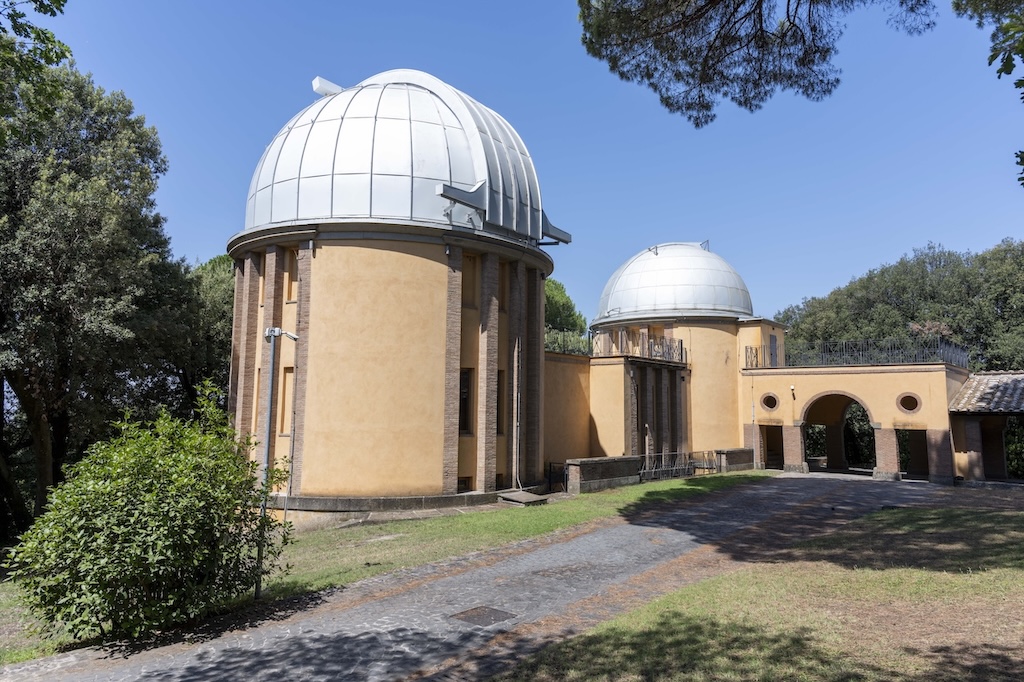
“(858334) Gioacchinopecci” honors Pope Leo XIII (1810–1903), baptized Gioacchino Vincenzo Raffaele Luigi Pecci. Pope Leo XIII re-established the Vatican Observatory following the loss of papal territories and the highly productive astronomical facilities contained therein (especially the observatory of Fr. Angelo Secchi, S.J., located atop the church of St. Ignatius in Rome). Photographs of the Vatican in the early twentieth century show the domes of observatory telescopes atop the walls of the Vatican and the “Tower of the Winds”. In the 1930s, because of electric lighting brightening the night skies over Rome, the telescopes were moved to the Apostolic Palace at Castel Gandolfo south of Rome. Their domes are still there, visible for kilometers in all directions. Further brightening of the Roman skies prompted construction of the VATT, on dark Mt. Graham, in the 1990s.
Pope Leo wrote, in his 1891 Motu Proprio “Ut Mysticam” establishing the Vatican Observatory, that the Observatory would help to show the world that the Church’s current and historic attitude toward “true and solid science” was (contrary to what detractors had been stating) to “embrace it, encourage it, and promote it with the fullest possible dedication.” And specifically, the Observatory would be “helping to promote a very noble science which, more than any other human discipline, raises the spirit of mortals to the contemplation of heavenly events.” The visible domes atop the Vatican walls and Castel Gandolfo have done these things in a very direct way for everyone, while the Observatory’s research output has done them for the scientific community.
There are other asteroids named for popes. “(560974) Ugoboncompagni” honors Pope Gregory XIII for his work on reforming the calendar. It was also discovered with the VATT. Pope Benedict XVI has “(8661) Ratzinger”, named by the astronomer Lutz Schmadel in 2000.
The process leading to the assignment of asteroid names is managed by the International Astronomical Union’s Working Group for Small Body Nomenclature (WGSBN). Asteroids are assigned provisional designations at the time of discovery, based on the date of observation. When an asteroid’s orbit has been determined with sufficient precision and its future trajectory can be reliably predicted, it is assigned a permanent number. Currently, approximately 850,000 of the roughly 1.3 million known asteroids have received a permanent number. Only after receiving this number can the discoverers propose a definitive name to replace the provisional designation. The proposed name is reviewed by the Working Group and must comply with specific guidelines. Once approved, the asteroid is known by its official name, written as “(number) Name”.
Thus “(836955) Lais” is named for Giuseppe Lais (1845–1921), an Oratorian priest and Italian astronomer who served as Deputy Director of the Observatory for thirty years. He was involved in the international “Carte du Ciel” (“Map of the Heavens”) photographic star atlas project of the early twentieth century. “(836275) Pietromaffi” honors Pietro Cardinal Maffi (1858–1931), Archbishop of Pisa, who served as President of the Observatory from 1904 till his death in 1931. He recommended that the Observatory be entrusted to the Society of Jesus to ensure high research standards. Jesuits operate the Observatory to this day. “(688696) Bertiau” is named for Florent Constant Bertiau (1919–1995), a Belgian Jesuit astronomer. He founded the Observatory’s Computer Center in 1965, pioneered computerized data analysis, and led vital research on distributions of stars in our Milky Way galaxy and on “light pollution” such as what forced the moves of the Observatory’s telescopes.
The discovery of these four asteroids and their naming by members of the Vatican Observatory continues Pope Leo XIII’s intention to support science and to show the world and the Church that faith and science go together.
